If you’ve been searching for homes in Broward County, you’ve probably already hit this wall: listings in Tamarac, FL show up under two names that look like they should be different neighborhoods but somehow keep pointing to the same streets. Anyone looking for the best neighborhoods in Tamarac, FL will likely encounter this naming issue. Throw in the fact that national search engines keep surfacing a massive master-planned community in Texas, and South Florida buyers end up genuinely confused about what they’re even looking at.
Here’s what matters for your search. The broader Tamarac housing market has a median sale price of around $314,792, with homes sitting on the market for roughly 84 days. But the properties clustered around the local country club represent a distinct segment of that market – different price tier, different lot sizes, different character entirely. Getting the geography straight first will save you a lot of time.
Understanding the Naming Confusion in Tamarac
The short answer: these two names refer to the exact same community. Both describe a single subdivision of roughly 883 to 890 homes built around the local golf course in Tamarac. Real estate agents, listings, and the people who live there use the terms interchangeably – there’s no street-by-street municipal boundary separating them, no reason to choose between the two.
The entire community sits within the 33319 ZIP code in Broward County. You’ll also see it called the Woodlands Country Club, depending on who’s writing the listing.
Geographical Boundaries for the Area
The community centers on Woodlands Boulevard, Bayberry Lane, and Royal Poinciana Lane, and it falls entirely within the Broward school attendance zone. Data aggregators and local tax records confirm that single-ZIP designation for every property in the subdivision.
Whether a listing uses one name or the other, it maps to the exact same physical location. Focus on the specific street and lot placement – that’s what tells you something useful.
Real Estate Market and Pricing
The citywide Tamarac median of $314,792 tells you something about the broader market, but not much about this particular community. The country club subdivision trades at a higher price point, and it stands out within the city’s overall inventory of 641 homes for reasons that are visible the moment you drive through – larger lots, custom builds, a scale that tract housing just doesn’t match.
Across Tamarac broadly, homes are selling for about 96.4% of list price, with roughly 7% selling above asking. In this subdivision, your financial expectations should shift accordingly.
Current Home Prices and Trends
Recent data puts the median sale price for homes here somewhere between $495,000 and $534,500, depending on the timeframe and source. Average sale price figures from various snapshots range between $513,208 and $593,000. The spectrum is genuinely wide – some homes have listed as low as $249,000, while expansive estates have reached up to $3,500,000.
One 12-month market view placed the median at $495,000, reflecting a 4% year-over-year decrease for the neighborhood. A separate December 2025 snapshot put the median at $524,500. The honest advice here is simple: pull recent comps for the specific street you’re targeting, because the range within this community is large enough that neighborhood-level averages only get you so far.
Property Taxes and HOA Fees
The community falls under Tamarac’s municipal tax district, Millage Code 3112. For 2025, Tamarac’s total millage rate ran roughly $21.10 per $1,000 of assessed value. Broward County’s overall median effective property tax rate is 1.44%, which runs higher than the national median of 1.02%.
Your actual annual tax bill depends on the home’s assessed value – for reference, one larger estate home in the community showed estimated annual taxes of $17,461. Verify the exact tax history on any property before you make an offer.
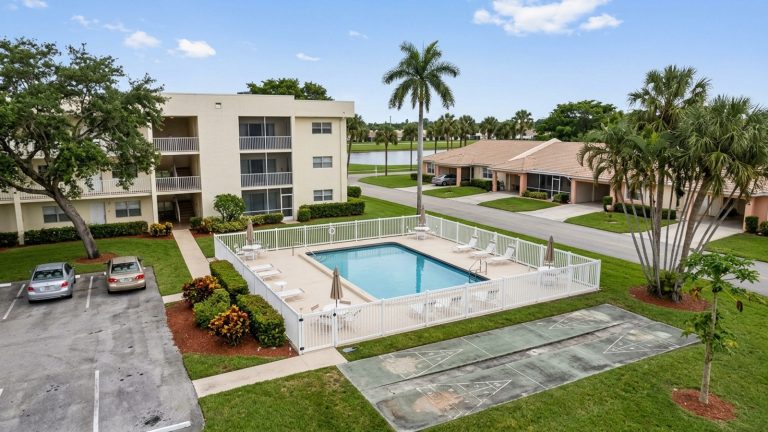
HOA structures here are worth understanding, because they vary more than you’d expect. Some sections – including certain estate homes on Woodlands Boulevard – carry no mandatory HOA fees at all. Other sections do: Section 2 charges $80, and there’s a 55+ subsection with $145 quarterly fees covering lawn maintenance and community amenities. Which section a home sits in matters more than the name on the listing.
Housing Types and Architecture
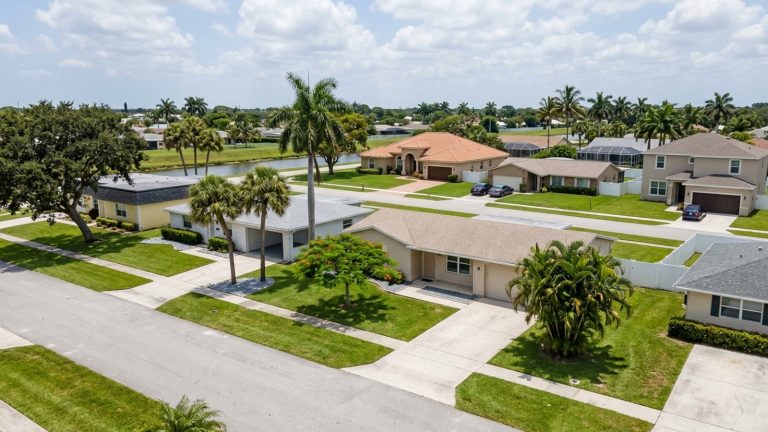
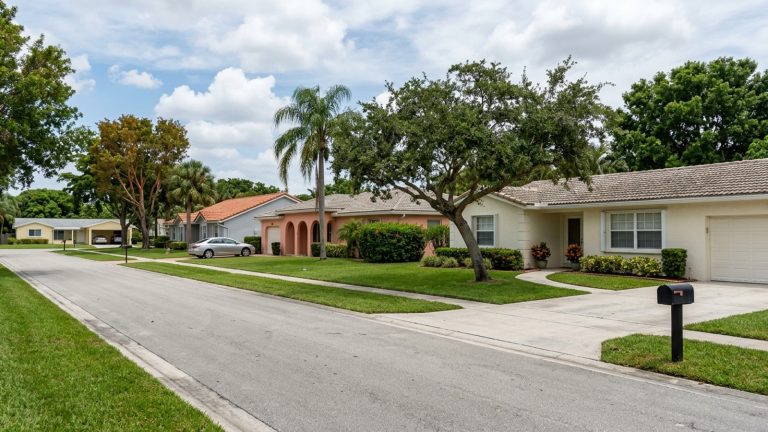
This community doesn’t look like standard tract housing, and that’s immediately obvious when you walk the streets. Custom builders developed the area over several decades – primarily between the 1970s and 1990s – which produced a mix of property types that genuinely varies block to block. The golf course integration shaped how these lots were laid out and how the homes sit on them.
Home Styles in the Community
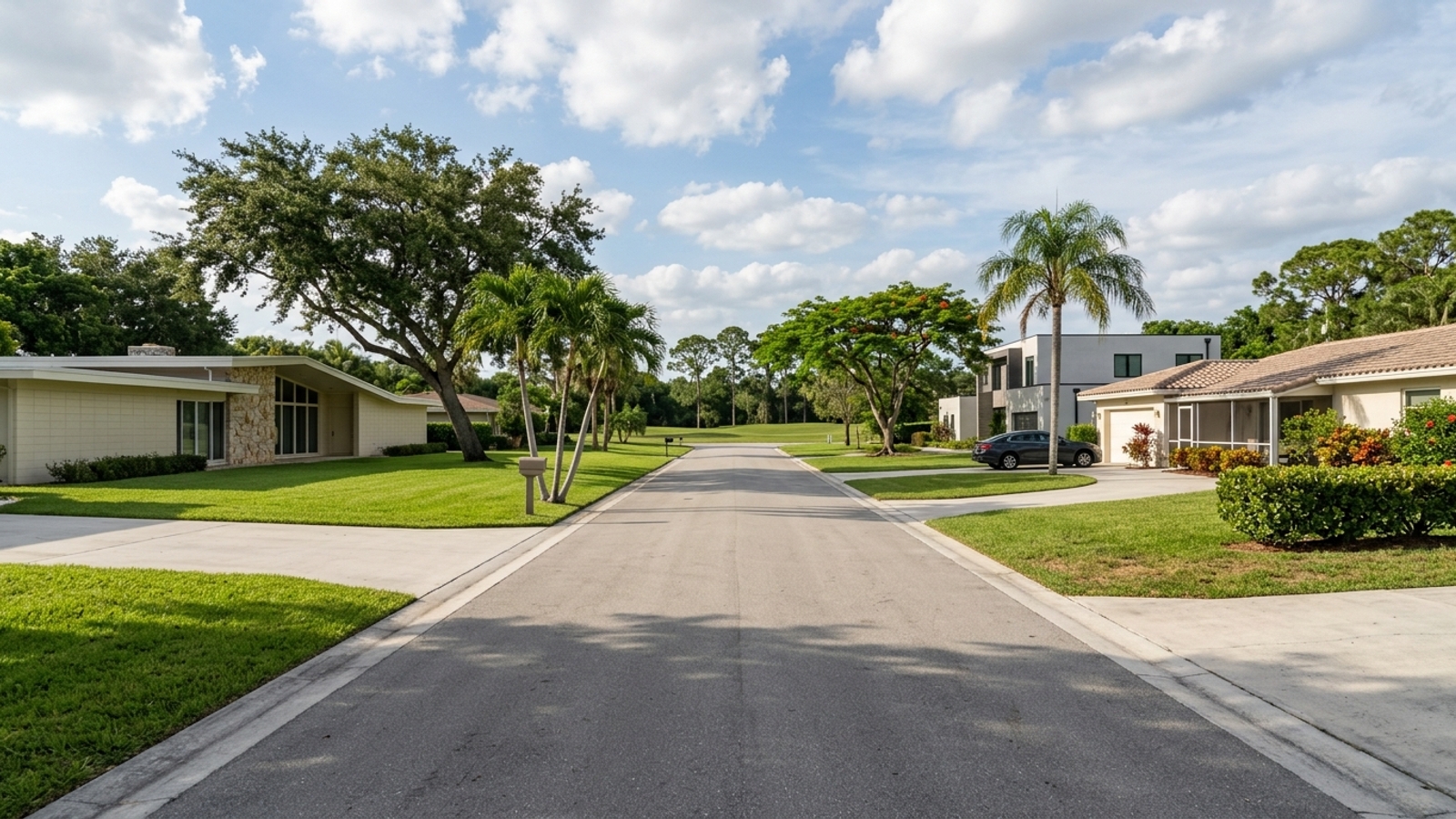
You’ll find sleek modern designs alongside classic ranch-style houses. Flat roofs are common, and many homes incorporate limestone or rock accents into their facades. Because multiple custom builders worked here over the years, floor plans don’t repeat the way they do in a standard subdivision – which means more legwork to find the right fit, but also more options if you have specific preferences.
The mid-century estate homes sit on large lots with generous setbacks from the street. There’s real character here, but it’s not uniform. Walk different sections before you settle on a target.
Commute, Transportation, and Accessibility
This community sits in a central part of Tamarac, and the proximity to major arterial roads is straightforward. Most commuters rely on nearby toll roads and state routes rather than surface streets – and for good reason.
Major Highways and Routes
Florida’s Turnpike has a direct interchange in Tamarac, giving you a fast north-south route through the county. Commercial Boulevard – State Road 870 – intersects the Turnpike within city limits, which makes the country club area genuinely convenient for daily travel in multiple directions. East-west access to coastal areas and other major highways runs through Commercial Boulevard as well.
Drive Times to Fort Lauderdale and Miami
Downtown Fort Lauderdale is about 13 to 15 miles from Tamarac, a trip that typically runs 21 to 29 minutes depending on your route and when you leave. For downtown Miami, you’re looking at roughly 34 to 35 miles – approximately 39 to 49 minutes via Florida’s Turnpike. That said, drive those routes during your actual commuting hours before you commit to anything. Published averages and rush-hour reality are not always the same thing.
Frequently Asked Questions
There is no physical difference between the two. Both names refer to the exact same subdivision of roughly 883 to 890 homes located in the 33319 ZIP code of Tamarac, FL. Local real estate agents and data sources use the names interchangeably.
No, because they’re the same neighborhood. Recent data shows the median sale price for this Tamarac community ranges from $495,000 to $534,500. The broader Tamarac city median is lower, sitting around $314,792.
No – they share the same tax district and overall HOA structure. The entire area falls under Tamarac’s Millage Code 3112, which carried a total rate of roughly $21.10 per $1,000 of assessed value for 2025. HOA fees vary by the specific section or street, not by which name appears on the listing.
No, because it’s a single community. The area features mid-century modern estate homes, classic ranch-style houses, and modern designs – homes built primarily between the 1970s and 1990s.
Commute times are exactly the same. The community sits minutes from the Florida Turnpike and Commercial Boulevard. A drive to downtown Fort Lauderdale takes about 21 to 29 minutes from this location.
Restrictions depend on the specific street or subsection, not the name. Some estate homes on Woodlands Boulevard have no mandatory HOA at all. There is a 55+ subsection within the community that charges $145 quarterly and enforces age restrictions – something to confirm before you get too far along in the process.
While this community features custom mid-century estates on large lots, buyers often evaluate other local subdivisions to compare architectural styles and HOA structures. Reviewing the Heathgate community in Tamarac provides a helpful contrast for those searching within the city limits. Both areas fall under the broader Tamarac market, where homes typically sit on the market for roughly 84 days.
Buyers interested in golf course integration often compare this subdivision to the Tam O’Shanter neighborhood to evaluate different lot layouts and property types. While this specific country club area features custom builds from the 1970s to 1990s, other local communities offer their own distinct architectural options. Checking multiple subdivisions helps clarify which specific street and lot placement best fits your preferences.